Tag Archives: Everson Museum of Art

Laurent Craste

Just when you thought you’d seen everything, you know what I mean?  Derivatives of derivatives of original artwork, materials driven artwork, Abstract Expressionist wanna-bes, etc., you go the The Everson Museum of Art (401 Harrison Street, Syracuse, New York 13202) and this happens…

…and it is AMAZING!

Laurent Craste is exhibiting his historically accurate vessels, which have been displayed with weapons that have seemingly destroyed them.  The juxtaposition of the delicate gold fleur-de-lis patterned porcelain attacked by actual baseball bats, axes, arrows and the like, is jarring.  It’s just the oddest thing and yet it speaks to the anger that peasants of the past had towards their regal governments.  I guess your reaction will depend on which of the two factions you associate with – are you a have or a have not???

It’s fascinating, intriguing…and beautiful!

from www.everson.org

Iconoclasts

Iconoclasts marks the American museum debut for French-born Canadian ceramist Laurent Craste. Over the past decade, Craste has committed a wide range of indignities and abuse against his ornate vases and urns, including pummeling them with baseball bats and crowbars and piercing them with arrows. Despite the violence that runs through his work, Craste has a great passion for historical porcelain. Working with porcelain allows Craste to explore the prestige and power of upper-class society, but also inequality and the strain that is placed on working people. The anthropomorphic nature of Craste’s vases echoes the human body, making it no surprise that people feel strong emotions when seeing a helpless vase struck by a baseball bat. Triggering these strong emotions in his audience allows Craste to connect on a deeper level as he asks questions about class, money, and power.

Join us for a special artist talk with Craste on Thursday, February 5, 2026. (see the website for exact time of the lecture) 

Mapping Joyce Kozloff

Joyce Kozloff’s exhibition at The Everson Museum of Art (401 Harrison Street, Syracuse, New York) maps her significant career as an artist.  It is a global view of society as seen through the veil of decorative pattern.

There is a distinct femininity about the work due to the color palette and the meticulousness of possibly holding a tiny paper between tweezers, laying it atop an old map that may have been located via browsing flea markets or antique shops then applying it to the artwork with glues, precision and painstaking patience, adding drawing, colored pencil and other media – and then multiplying that effect by all the pieces presented in this show that were created over forty years.

The dedication to this process and the willingness to continue to both work and present the epic conclusion not as a retrospective but as a rest stop on the road to the next and the next addition to her travels is truly inspiring.

I am in awe of the beauty of this showcase. The way the three dimensional pieces mimic the ideals of the collages, the way the vintage, current and even celestial maps are layered to become something other, as though Kozloff has created a new world that is truly breathtaking – it’s soooo good.

I stood inside the sphere in the center of the second gallery – a sort of echo chamber that allowed me to pretend I was Jodie Foster in the movie “Contact”, an explorer heading to another realm.  One could spend hours in there inspecting all the detail.

I guarantee students would love this and I encourage local art teachers to plan a field trip soon.

The Joyce Kozloff: Contested Territories (1983-2023) exhibition runs through April 5, 2026.

Oh, and this thing (above) spins!

Joyce Kozloff (b. 1942) is a major figure in both the Pattern and Decoration and the Feminist art movements of the 1970s. In 1979, she began to focus on public art, increasing the scale of her installations and expanding the accessibility of her art to reach a wider audience. Kozloff has since executed a number of major commissions in public spaces across the globe, most recently Memory and Time at the Carroll A. Campbell Jr. United States Courthouse in Greenville, South Carolina. Since the early 1990s, Kozloff has utilized mapping as a device for consolidating her enduring interests in history, culture, and the decorative and popular arts. Her work is in public collections across the country including the Brooklyn Museum, Brooklyn, NY; the Jewish Museum, New York, NY; the Metropolitan Museum of Art, New York, NY; the National Gallery of Art, Washington, DC; and the Whitney Museum of American Art, New York, NY. Kozloff received a BFA from Carnegie Institute of Technology, Pittsburgh, PA in 1964 and an MFA from Columbia University in 1967.

Art Talk: Lessons In Geometry

Today I visited The Everson Museum of Art (401 Harrison Street, Syracuse, New York 13202) for the Steffi Chappell-led art talk.  It was a Lesson in Geometry.

As Director of Curatorial Affairs, Chappell curated this exhibition from the Everson archives.  Currently, the museum’s finest collection of non-representational paintings and sculptures are housed in two of the upstairs galleries.  Works from Sol Lewitt, Susan Roth, and many other American artists are on view through March 29, 2026.  Some of the pieces are recent acquisitions.

When discussing geometric forms, we are talking about measured shapes.  Drawing a circle free-hand is not geometry.  These pieces utilized rulers, protractors, right triangles and compasses.  Many were conceptualized to appear machine made with very smooth brushstrokes and precise edges (I mean – you can totally tell those artists used masking tape in order to eradicate  the humanity – so that was a bit of an unsuccessful desire).

Steffi Chappell spoke of the historical significance of the abstract art movement in the United States specifically, and how it sort of separated into factions with Abstract Expressionism dominating after World War II.  Geometric Abstraction sprouted from a need to break free of emotional trappings.

Even though many of these pieces were created when I was a child (kind of a long time ago), it was refreshing in that Star Trekkian way to do away with all the emotion and volatility of social justice art, mental illness art, low frequency vibes and the like, at least for the afternoon.  This work, in essence, is art for art’s sake.  It is about using the elements of art to establish the principles of art in a structured instead of intuitive way.

The result:  the viewer responds to color, rhythm, line quality, etc. and appreciates its boldness in size or serenity in shape.  Many artists experimented with canvas shape, new materials, and/or optical illusion.

It’s the kind of abstract art that kids will hesitate to say – I could do that – because the underlying geometric structures and measuring techniques were clearly time consuming, lol.

Artists have obsessed over the relationship between mathematics and art for millennia. As artists turned toward abstraction in the early twentieth century, Europeans like Piet Mondrian used geometry to create a set of rules and parameters that guided their creative process. Meanwhile, American artists began developing their own styles and movements—particularly Abstract Expressionism, which was typified by bold, quickly executed brushwork, drips, and splashes. In the mid-twentieth century in the United States, artists laid the groundwork for Geometric Abstraction as a more cerebral alternative to the often macho flamboyance of Abstract Expressionism. Over the ensuing decades, artists used geometry to produce abstract works that ranged from the dazzling Op Art of Victor Vasarely to the restrained Minimalism of Sol LeWitt.

Lessons in Geometry traces the evolution of hard-edged abstraction in the United States as artists sought to use pure geometric forms to create works with balance, harmony, and order. For these artists, shape, line, and color took precedence over representational compositions. The Everson’s collection reflects the wildly varied ways that artists have used geometry to serve their personal expression, from the analytical formulations of Robert Swain to the shaped canvases of Harmony Hammond and the spatial illusions of Tony King.


Picking Up the Pieces

Maria Park:  Field Diagram is the latest CNY Artist Initiative  exhibit to grace the walls of the Members’ Council art gallery at the Everson Museum Of Art (401 Harrison Street, Syracuse, NY 13202).

These pieces do not photograph well – they are made to look like resin but they are acrylic paintings on panel with a plexiglass face, cut into amorphous shapes that resemble diamonds and other fine minerals.  There is a femininity to them and a sort of fragility as well, as if they could shatter and then we’d all drown in our own tears.

I thought my life would end like that after I received unsettling news on Monday morning.  We all have some mental drama/anguish that seems to subside via the creation of art.  In Maria Park’s case, her partner and collaborator, Brandon Hookway, passed away.  This heart-wrenching trauma resulted in time away from their joint studio.

Six months later, Maria Park began to pick up the pieces and this show is evidence that art can be a form of therapy.  What was once a partnership in life becomes a fusion of art and love.

This emotional backstory certainly resonates with many and I think, if you visit the museum to see the show in person, you will understand its gravitas.

(P.S. In my case, nobody died).

Maria Park:  Field Diagram remains on view through October 26, 2025.

Children of the Clay

The Feats of Clay competition will take place on May 2, 2025 at the Everson Museum of Art,  This is a school competition that includes wheel throwing and other fun timed sculpting events.

A juried exhibition of student work is currently on display at the Everson (downstairs in the auditorium atrium).  So fun!

Feats of Clay (from www.everson.org)

Central New York’s Feats of Clay competition was established in 1987 to foster education in the ceramic arts for Syracuse-area high schools. Now in its 36th year, the event includes schools from as far away as the North Country and the Southern Tier and features a juried exhibition that recognizes students who demonstrate excellence in ceramic sculpting and vessel making.

On Friday, May 2, 500 students representing more than twenty-five schools will converge on the Everson Community Plaza to compete in a series of Olympic-style competitive events that involve (among other things) throwing blindfolded on the potter’s wheel, stacking wheel-thrown cylinders, and building towering constructions out of clay coils.

Feats of Clay is supported by Clayscapes Pottery and the Independent Potters Association.

Waxing Politic

I used to deliver newspapers – The Syracuse Herald Journal and the Sunday Post Standard.  I started as an eight-year-old, making $20 a week.  Back in the ’70s, that was a lot of money. I was able to buy a car when it was time for that, and other stuff, like a TV and stereo for my bedroom….

I always thought I’d be a writer, an artist too, but – I don’t know, I mean, I used to read the paper every day back then.  Was I going to be a Lois Lane?  Now the paper is a relic and maybe I am partly to blame because I write for fun, not for money.  And you can read it for free.

Years ago, Tim Atseff was hired as an artist for the Syracuse Herald Journal.  That job segued into political cartoonist and later upper management.  He was more recently instrumental in creating the Central New York Magazine and other publications that focus on local interests.

He’s still very much an artist and this exhibition at the Everson Museum of Art is a powerful homage to his career.  Atseff paints on bifold insulation boards in his basement studio.  The artwork is enormous and yet easily transportable, which I find genius.

The work focuses on the current political climate and incorporates assemblage, collage, text and a vibrant color scheme.

The paintings succeed in joining technical proficiency with abstract and graphic devices, which manifests into a Robert Indiana/Larry Rivers-type vibe, something akin to a powerful Americana symbolism juxtaposed with a feeling of unfinished business.

As well, I recognized that the artists’ own political views are not unclear yet, like the propaganda of politics, the work can justly be claimed by the opinionated based on perspective alone, if that makes any sense.

I loved the scale of it all, the large headline texts and the humor (calling the paper in one painting “The Daily WTF”), the giant -30- indicating the end of a news story….  The installation elements are full of smaller items, like the sand on the floor in the Final Edition piece had pennies sprinkled in – this was not lost on my eagle eye.  There is perfection in that rhythm.

There is such a strong message here about the loss of a media that at one time was our main source of information, given to us by just-the-facts-journalists.  Now who are we supposed to rely on for that info?  Lois Lane is out of a job and I am assuming there’s no pension.  Thank goodness I went the teaching route so that my art and writing stuff can remain in the realm of for-fun.

This show is about the end of an era, an American institution in rags, in shambles.  The newspaper thrown out like yesterdecade’s garbage.  It’s bittersweet and beautiful, and larger than life.  So SO GOOD!

Tim Atseff – Final Edition will be on view through December 29, 2024.  The Everson Museum of Art is located at 401 Harrison Street, Syracuse, New York, 13202.  See their web-site for further details including hours of operation and how to become a member in order to support the museum and keep up-to-date on future events..

Manuel Matias

Recently, a friend was reflecting on something that happened over thirty years ago, remembering every shitty thing in minute detail as if it happened yesterday, trying to extrapolate why it was still in the present moment.

I guess this is the norm for some, and in the case of Manuel Matias, his reflections are visual rather than verbal recollections. They are little three-dimensional maquis, placed under glass to inflate their importance, of memories heavily laden with pop culture references.

They are supposed to be vignettes of store fronts that capture the gritty sights and smells of the Manhattan lower east side of his youth. It is art as social commentary.

I was in an emotional disconnect when I viewed this show because I didn’t relate to any of it. But maybe you will. It’s in that gallery way in the back on the first floor, the one that nobody sees.

The exhibition is at the Everson Museum of Art (401 Harrison Street, Syracuse New York 13202) through August 18, 2024.

On Saturday, July 13, 2024, Manuel Matias will be on hand for Everson’s Community Day. From 11:00 AM – 2:00 PM they are having a pay-what-you-wish deal plus art kits for children with materials to create mini Matias-like dioramas with the artist’s blessing.

Hours:

Monday: Closed
Tuesday: Closed
Wednesday: 11:00am – 5:00pm (Pay-What-You-Wish all day)
Thursday: 11:00am – 8:00pm (Thursdays from 5:00-8:00pm are Pay-What-You-Wish)
Friday: 11:00am – 5:00pm
Saturday: 10:00am – 5:00pm
Sunday: 10:00am – 5:00pm

Claying

For the last two years, Natasha Smoke Santiago, who goes by Smoke, has been involved in a residency with the Everson Museum of Art (401 Harrison Street, Syracuse, New York). This situation has culminated in an art exhibition in the Robineau Gallery.

The clay pottery is paired with artifacts that coordinate with her Haudenosaunee heritage. She is Mohawk.

The pottery is functional, meant to be used in food preparation, as well as ceremonially.

The exhibit continues through August 18th, 2024.

Hours:

Monday: Closed
Tuesday: Closed
Wednesday: 11:00am – 5:00pm (Pay-What-You-Wish all day)
Thursday: 11:00am – 8:00pm (Thursdays from 5:00-8:00pm are Pay-What-You-Wish)
Friday: 11:00am – 5:00pm
Saturday: 10:00am – 5:00pm
Sunday: 10:00am – 5:00pm

Flatsies with Boobies

The Robineau Gallery at The Everson Museum of Art, adorned with ceramic and mixed-media sculptures, tells the story of Sana Musasama’s artistic journey through a personal and global history of art/architecture and toys.

This is the fourth time I’ve viewed an African-heritage artist use dolls to commemorate their artistic journey. I am feeling inspired to incorporate the idea in my own work. I have already gone the houses route.

These six-inch slab dolls are so unique. I love the way the legs are connected separately. The beads are attached with pipe cleaners. If the dolls didn’t have boobs, they would make a great sample/inspiration for a second grade clay project.

Sana Musasama: Returning to Ourselves will be on display February 3 – April 28, 2024.

The Powerful Legacy

If you need another reason to visit the Everson Museum of Art, Mara Baldwin’s work is there. But hurry, because the exhibition ends on August, 6th, 2023.

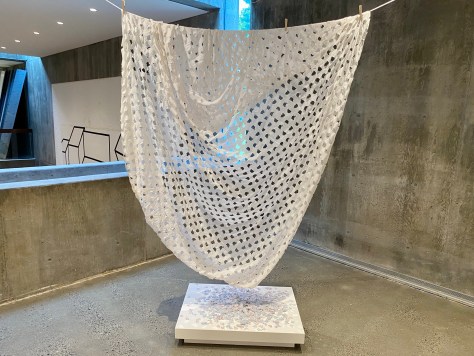
Mara Baldwin is an educator, artist and historian, studying the artwork of local female artists like Adelaide Robineau. Baldwin pays attention to the detail and intricacies of Robineau’s carvings and replicates the essence into fiber art that hovers the walls and leaps off into three-dimensional space in this tiny tucked-away-in-the-way-back gallery on the museum’s first floor.

The exhibit is part of a local artist initiative, which is a good thing, but really – why not put the museum store in that space? Tucked away would not be an issue because shoppers can sniff out a store. Everybody knows that.

It would be a shame if visitors missed this show. Mara Baldwin tackles personal and historical conundrums about life and the pursuit of goals, happiness and freedoms while weaving herself into the fiber of that history with modern aplomb.

We are all a part of that collective fabric. Just don’t blink and miss it.